Breast Implant Revision Abroad: Questions About Replacement Options and Long-Term Care
Breast implant revision abroad can be an opportunity to address concerns about implant ageing, changes in breast shape, discomfort, asymmetry, or a previous surgery that no longer meets your expectations. However, revision surgery is more complex than a first-time breast augmentation because the surgeon must assess existing implants, scar tissue, breast tissue, skin quality, and the condition of the implant pocket.
If you are considering breast implant revision in Türkiye, asking detailed questions before travelling is essential. A reliable international patient provider, such as Barutçu Global, can help coordinate consultations, medical records, treatment planning, travel arrangements, and follow-up communication. The final surgical decision, however, should always be made after an assessment by a qualified plastic surgeon.
Why might someone need breast implant revision surgery?
Breast implants are not lifetime devices, although they do not automatically need to be replaced after a fixed number of years. Revision may be recommended or considered for several reasons, including:
- Implant rupture, leakage, or suspected damage
- Capsular contracture, when scar tissue around the implant becomes unusually firm or painful
- Implant displacement, rotation, or bottoming out
- Breast asymmetry or changes in breast shape
- Rippling, visible edges, or implant palpability
- Changes after pregnancy, breastfeeding, weight fluctuation, or ageing
- A desire to change implant size, shape, or projection
- Concerns about the appearance or feel of the original implants
- Removal of implants, with or without a breast lift
Revision surgery may involve implant replacement alone, but some patients need additional procedures to improve the breast envelope or strengthen the implant pocket.
How is breast implant revision different from primary augmentation?
During a first breast augmentation, the surgeon creates an implant pocket in relatively untreated tissue. Revision surgery must take into account previous incisions, scar tissue, stretched skin, changes in muscle or breast tissue, and the position of the existing implant.
The operation may therefore require more detailed planning. Depending on the findings, the surgeon might recommend a capsulectomy, removal of part or all of the scar capsule, pocket adjustment, implant replacement, fat grafting, breast uplift, or implant removal. The appropriate approach depends on your anatomy, symptoms, previous surgical technique, and aesthetic goals.
What implant replacement options should I ask about?
Ask your surgeon to explain all reasonable options rather than assuming that replacement with a similar implant is the best solution. Important questions include:
- Would you recommend replacing the implant, removing it, or changing its size?
- Would a different implant shape, profile, or surface be appropriate?
- Should the implant be placed above or below the muscle?
- Is the existing implant pocket suitable, or does it need to be revised?
- Could fat transfer improve contour or reduce visible implant edges?
- Would a breast lift be needed because of skin stretching or sagging?
- What are the benefits and limitations of using a smaller or larger implant?
Implant selection should be based on your tissue characteristics, chest dimensions, skin elasticity, and desired result—not only on a preferred volume. A surgeon should explain why a particular implant type and placement are being recommended.
Should I choose silicone or saline implants for revision surgery?
Both silicone and saline implants may be used in breast surgery, but their suitability varies from person to person. Silicone implants are widely chosen because they generally provide a natural feel and may be less visibly rippled in some patients. Saline implants contain sterile saltwater and may offer different considerations if a rupture occurs.
Ask about the implant’s filling material, shell, shape, profile, manufacturer, warranty terms, and expected monitoring requirements. You should also receive clear information about potential complications and the fact that no implant can be guaranteed to last forever.
Your surgeon should discuss the available options approved or legally available in the country where surgery will take place. Do not select an implant solely because it is advertised online or associated with a particular trend.
What tests or scans may be needed before revision?
The evaluation may include a physical examination, review of your surgical history, and assessment of your current implants. If rupture or another implant problem is suspected, the surgeon may recommend imaging such as ultrasound or magnetic resonance imaging (MRI). Mammography may also be relevant depending on your age, screening history, and medical advice.
Before travelling, send copies of previous operation reports, implant cards, imaging results, pathology reports, and photographs if requested. If you do not have complete records, tell the medical team. Missing information does not necessarily prevent an assessment, but it may affect planning.
What is capsular contracture, and how is it treated?
A capsule of scar tissue naturally forms around an implant. In some cases, this capsule becomes tight, thickened, painful, or visibly distorting. This condition is known as capsular contracture.
Treatment may involve releasing or removing part of the capsule, removing the implant, changing the implant pocket, replacing the implant, or using another surgical technique. The recommended procedure depends on the severity, recurrence history, and condition of the surrounding tissue. Ask your surgeon:
- Is capsular contracture present or likely in my case?
- How much of the capsule would need to be removed?
- What can be done to reduce the risk of recurrence?
- Would implant replacement or removal be more appropriate?
Although surgeons may use strategies intended to reduce recurrence, no method can eliminate the possibility entirely.
What should I know about implant rupture and breast implant safety?
An implant rupture may be noticeable or silent. Silicone implant rupture can sometimes be detected only through imaging, while saline implant rupture may result in a gradual loss of volume as the body absorbs the saline. A suspected rupture should be assessed by a qualified clinician.
You should also ask about the rare association between breast implants and breast implant-associated anaplastic large cell lymphoma (BIA-ALCL), a type of lymphoma linked mainly to certain textured implant surfaces. BIA-ALCL is uncommon, but patients should understand possible warning signs, including persistent swelling, a mass, or pain developing around an implant, often years after surgery. These symptoms do not automatically indicate BIA-ALCL, but they require medical evaluation.
Ask which implant surface is being proposed, why it is recommended, and how you will be informed about product safety updates.
Could implant removal without replacement be an option?
Yes. Some patients choose explantation, meaning removal of the implants without inserting new ones. This may be considered because of personal preference, complications, changes in lifestyle, health concerns, or a desire for a more natural appearance.
After removal, the breast may have loose skin, reduced volume, or changes in shape. A breast lift can sometimes improve the contour, while fat transfer may add modest volume in selected patients. Your surgeon should discuss realistic expectations, including the possibility that the breast will not return to its pre-augmentation appearance.
How can I evaluate a surgeon for revision surgery abroad?
Look for a specialist who is appropriately qualified in plastic, reconstructive, and aesthetic surgery and who regularly performs breast revision procedures. Ask about:
- Professional registration and specialist qualifications
- Experience with your specific complication or revision goal
- Where the surgery will take place and whether the facility is appropriately accredited
- The surgeon’s approach to informed consent and risk management
- How complications are handled during and after your stay
- Who will provide follow-up care once you return home
Before agreeing to treatment, request a personalised surgical plan rather than relying on standardised package descriptions or edited before-and-after photographs. Results vary according to anatomy, healing, implant history, and the procedure performed.
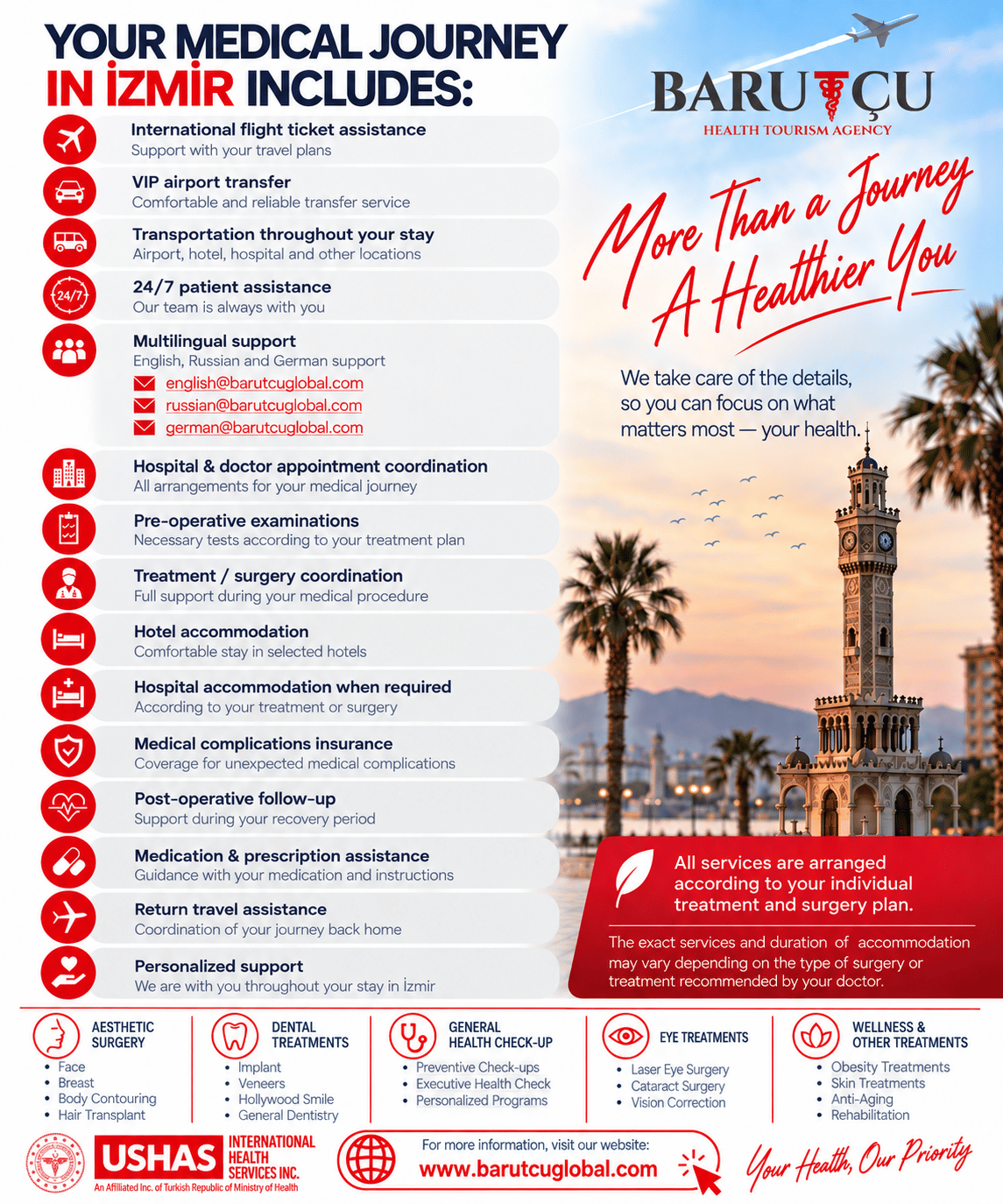
What should be included in the medical tourism package?
Ask for a written breakdown of what is included and excluded. This may cover the surgeon’s consultation, hospital or clinic fees, anaesthesia, implants, medications, compression garments, transfers, accommodation, and post-operative checks. Confirm whether additional nights, laboratory tests, imaging, treatment of complications, or a second procedure would incur separate costs.
You should also know the planned length of stay in Izmir or another destination in Türkiye, how many appointments are expected, and what happens if the surgeon recommends a different procedure after examination.
How long should I stay abroad after breast implant revision?
The recommended stay depends on the extent of surgery, your recovery, and the surgeon’s assessment. A straightforward implant exchange may have a different recovery plan from a revision involving capsulectomy, breast lift, or tissue repair.
Do not book a return flight until the medical team confirms that travel is reasonably appropriate. Air travel, luggage handling, physical exertion, and limited access to care can affect recovery. You should receive written instructions about wound care, medication, showering, exercise, sleeping position, and warning signs.
What long-term care will breast implants require?
Long-term care includes routine breast health checks and attention to new symptoms. Continue age-appropriate breast screening and tell the imaging team that you have implants, as special views may be needed. Your surgeon may also recommend periodic clinical reviews or imaging, particularly for silicone implants or if symptoms develop.
Contact a healthcare professional if you notice persistent swelling, a new lump, increasing firmness, pain, changes in breast shape, skin changes, or sudden loss of volume. Keep your implant details, operative report, and any imaging results in a secure place so they are available to future healthcare providers.
What questions should I ask before booking breast implant revision abroad?
Before making a decision, ask:
- What is the likely cause of my current concern?
- What are my options, including implant removal?
- What result is realistically achievable?
- What are the significant risks and possible complications?
- Which implant will be used, and why?
- Will I need a lift, fat transfer, or capsule surgery?
- How long should I remain in Türkiye after the operation?
- Who will manage my care if I develop a problem after returning home?
- What documents will I receive before leaving?
Conclusion: plan revision surgery with complete information
Breast implant revision abroad should be approached as a carefully planned medical decision, not simply an implant exchange. Understanding replacement options, possible additional procedures, long-term monitoring, travel arrangements, and aftercare can help you make a more informed choice.
Barutçu Global can support international patients exploring breast implant revision in Izmir and Türkiye by helping coordinate communication and treatment logistics. Your consultation should result in a clear, personalised plan, realistic expectations, and a reliable pathway for follow-up care before you proceed.