Hair Transplant Abroad: A Guide to Choosing a Clinic and Surgeon
Hair transplantation abroad is an important option for international patients who want to work with experienced teams and combine treatment with a travel plan. However, choosing the right clinic and surgeon requires a much more comprehensive assessment than simply comparing prices. Medical competence, personalized planning, hospital safety, communication, accommodation, and post-treatment follow-up should all be considered together.
Turkey is one of the countries frequently preferred by international patients for hair transplantation. In addition to Istanbul, cities such as Izmir, which offer well-developed healthcare services and transportation options, may provide different alternatives for patients traveling for treatment. This guide has been prepared to help people planning a hair transplant abroad make more informed and safer decisions throughout the process.
What should be considered before deciding to have a hair transplant abroad?
The cause of hair loss, its extent, the condition of the donor area, and overall health conditions vary from patient to patient. Therefore, general information found online or another person’s experience does not directly constitute a treatment plan for you. The first step is to have your hair loss medically evaluated and for a specialist to determine whether hair transplantation is an appropriate option.
During an online pre-assessment, you may be asked to provide clear photographs showing the hairline, crown, frontal area, and donor area. However, a photographic assessment does not always replace an in-person examination. Before contacting the clinic, it is important to find out which stages will be conducted online and which will be carried out in person.
Having realistic expectations
The aim of hair transplantation is to create a more natural and balanced appearance by using the available donor capacity. The same density or the same hairline cannot be achieved in every patient. Age, the likelihood of further hair loss, hair structure, and the capacity of the donor area may affect the outcome. A reliable surgeon explains the possible results without exaggeration and also evaluates the possibility of requiring additional sessions when necessary.
What criteria should be considered when choosing a clinic?
When having a hair transplant abroad, examine not only the clinic’s promotional materials but also its medical and operational structure. The following points may help guide your decision-making process:
- Legal authorization: Research whether the clinic operates in compliance with the healthcare regulations of the country where it is located.
- Medical team: Clarify who will perform the procedure, what role the surgeon will have during the operation, and what training the team has received.
- Hygiene and sterilization: The procedure should be performed under appropriate healthcare conditions using sterile equipment and safe protocols.
- Personalized planning: Be cautious of centers that recommend the same number of grafts or the same technique to every patient.
- Transparent communication: The scope of the procedure, pricing, possible additional costs, and follow-up process should be provided in writing.
- Post-treatment support: Find out who will answer your questions and through which channel after you return to your country.
Reviews on the clinic’s website and before-and-after photographs may be helpful when making a decision; however, they are not sufficient evidence on their own. Pay attention to whether the photographs were taken under the same lighting, from the same angle, and with the same hair length, how long after treatment the results were recorded, and whether the patients gave explicit consent.
Why is choosing the surgeon critically important?
Although hair transplantation may be viewed as an aesthetic procedure, it requires surgical knowledge, a strong understanding of anatomy, and safe patient management. For this reason, the qualifications of the physician who plans and performs the procedure should be researched just as carefully as the clinic itself.
You may ask the following questions before your consultation:
- Which physician performs the hair transplant planning and medical assessment?
- What are the responsibilities of the surgeon and medical team during the operation?
- Which options are being considered for my type of hair loss and donor area?
- How will the hairline and graft distribution be planned?
- What are the possible complications, and what protocols does the clinic follow to address them?
- How are follow-up appointments conducted after the procedure?
Be cautious if you cannot communicate directly with the physician, if only the sales team answers your questions, or if the healthcare personnel who will be involved in the procedure are not clearly identified. In a reliable process, the patient should clearly know who is responsible for making medical decisions.
About hair transplant techniques such as FUE and DHI
FUE and DHI are commonly encountered terms related to hair transplantation. In FUE, hair follicles are extracted individually from the donor area and placed in the planned area. With the DHI technique, grafts may be implanted using a special implanter pen. The technique to be used should be determined according to the pattern of hair loss, the characteristics of the donor area, the recipient area, and the surgeon’s assessment.
No technique can be described as the best or newest option for every patient. Rather than focusing only on the name of the technique, the clinic should be able to explain why the procedure is recommended and how it relates to your anatomical characteristics.
What should be considered when comparing prices?
Hair transplant prices abroad may vary depending on the country, clinic, number of grafts, technique used, and the scope of the package. Choosing only the lowest price may not be the right approach in terms of medical safety and long-term results.
When requesting a quote, ask in writing whether the following services are included in the price:
- Doctor’s examination and treatment planning
- Laboratory tests or necessary medical assessments
- The procedure and use of the clinic
- Medications and post-procedure care products
- Airport transfers and accommodation
- Follow-up appointments and communication support after returning to your country
Claims such as “unlimited grafts,” “guaranteed results,” or promises of definite density within a short period should be carefully evaluated in healthcare services. The number of grafts should be planned by considering the safe limits of the donor area and the future progression of hair loss.
Travel and preparation before treatment
Ask the clinic for a written preparation checklist before the procedure date. Inform the medical team fully about the medications you use, your known medical conditions, allergies, and any previous operations. Decisions regarding blood-thinning medications or chronic conditions should be made only by your doctor; do not stop taking medications on your own.
It may be helpful to allow sufficient time between the procedure date and your return date in your travel plan. Since crusting, redness, or swelling may occur during the first few days, ask the clinic about appropriate timing for transportation to the airport and your flight. Prepare your passport, visa, travel insurance, medical documents, and emergency contact numbers in advance.
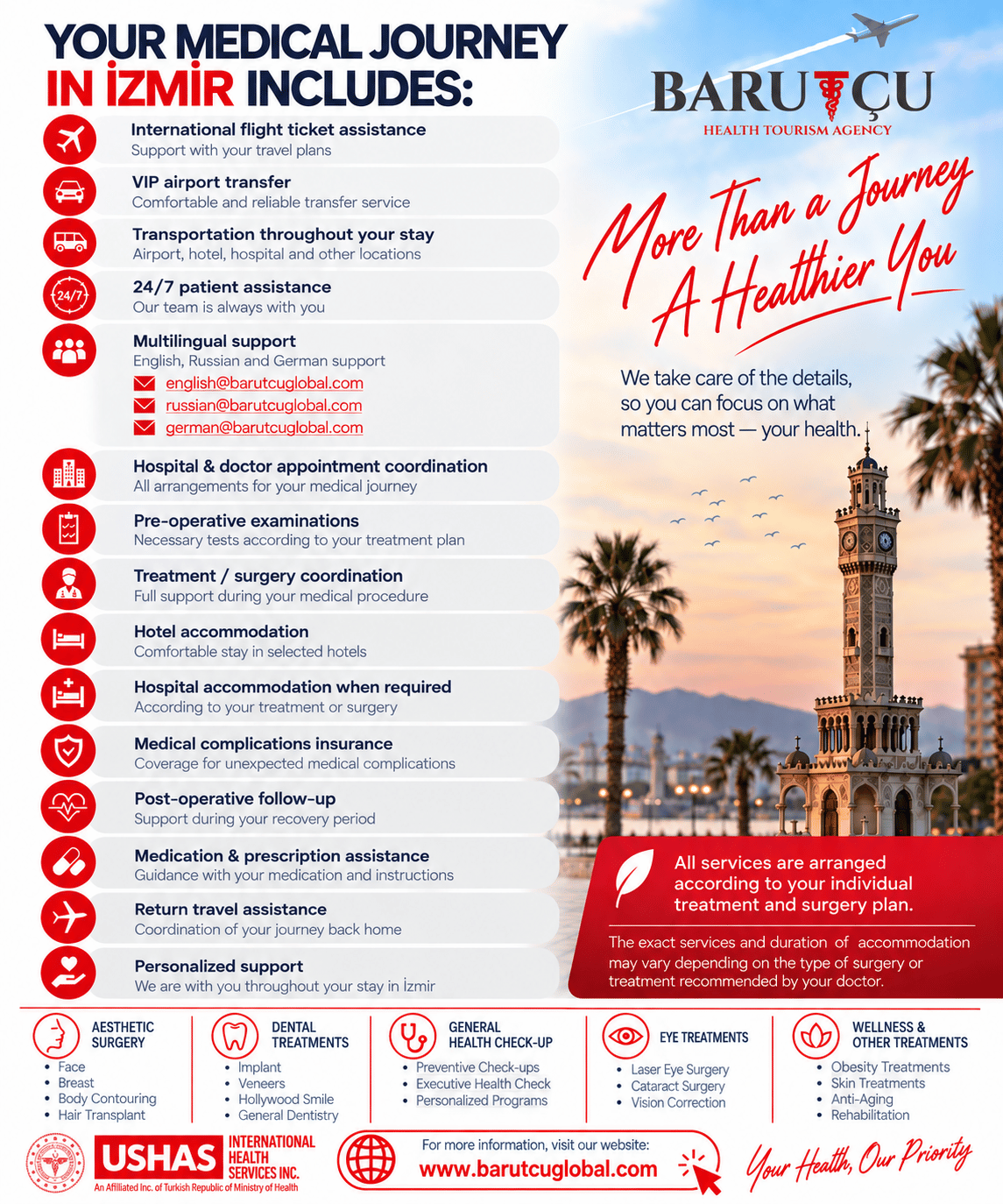
For international patients planning treatment in Izmir, airport transportation, the distance to the accommodation, and clinic-hospital coordination should also be evaluated. Barutçu Global may help organize the communication process so that international patients can receive support with pre-treatment information, appointments, transfers, and process coordination. Medical decisions, however, should be made by the relevant specialists.
Communication and language support
In international healthcare services, accurate communication is an important part of medical safety. The diagnosis, scope of the procedure, risks, expectations, and care recommendations should be explained in a language the patient can understand. Request professional interpreter support when necessary. Contracts or information materials prepared using automated translation, with unclear medical details, should be clarified before being signed.
Find out whether the clinic has a designated contact person who can be reached in an emergency or after you return to your country. It is also useful for procedure records, prescriptions, and care instructions to be provided in writing and, if possible, in English or your preferred language.
What you should know about the post-treatment process
After a hair transplant, it is important to follow the clinic’s care instructions. The clinic should explain how to touch the transplanted area during the first few days, when and how to wash the hair, when physical activities can be increased, and how follow-up appointments will be conducted.
The results of a hair transplant do not appear immediately. The growth process of the transplanted hair may take time, and changes observed during the early period may not represent the final appearance. Determine in advance at what intervals follow-up photographs should be sent and whom to contact if an unexpected symptom occurs.
If severe or worsening pain, widespread redness, fever, heavy bleeding, significant swelling, or any other concerning symptoms occur, contact the medical team without delay. In emergencies, seek support from healthcare services in the country where you are located.
Red flags when choosing a reliable clinic
- Promises of definite results or a definite number of grafts without conducting an examination
- Failure to disclose the name and responsibilities of the physician performing the procedure
- Unrealistic guarantees regarding density and success
- Failure to explain the risks, alternatives, and possible need for additional sessions
- Failure to provide a written contract or a detailed breakdown of costs
- Insufficient information being collected about the patient’s medical history
- No post-treatment communication or emergency plan
Conclusion: Do not base your decision solely on price
When planning a hair transplant abroad, the best approach is to evaluate the clinic’s legal and medical structure, the surgeon’s experience, personalized treatment planning, communication support, and post-treatment follow-up together. Before choosing a center in Turkey or Izmir, review the relevant documents, ask all your questions in writing, and openly discuss your expectations with the specialist.
A safe medical tourism experience requires well-planned travel and continuous communication as well as treatment. Barutçu Global offers guidance during the information-gathering and process coordination stages for international patients, while reminding patients that each individual’s medical assessment must be conducted by authorized healthcare professionals.